
The EU Regulatory Super-Cycle: ESPR, DPP and CSRD for Your BOM
Most procurement teams are preparing for one regulation. The EU has passed several.
 Open full-size image
For fifteen years compliance has worked like a gate: confirm RoHS, confirm REACH, sign the part off, move on. The rules were stable enough that the check could be done once and then forgotten about.
Five instruments now in force or in transposition break that, and not because any one of them is dramatic. ESPR, the Digital Product Passport, CSRD, CSDDD and the Right to Repair Directive each ask a different question, and every one of the answers sits in the same place: the component-level data behind your bill of materials.
Selectronyx surfaces the component-level data these rules depend on. It does not generate Digital Product Passports, CBAM filings, CSDDD submissions or carbon records, and it does not certify conformity to any of them.
The regulatory landscape: what has actually passed
A good deal of what circulates about these rules is either out of date or describes a draft that changed. What follows is the position as it stands.
- RoHS Recast 2011/65/EU, as amended by RoHS 3 (EU) 2015/863. In force. Restriction of hazardous substances, including the four phthalates added by RoHS 3. Compliance documentation required per product.
- REACH SVHC. In force. Substances of Very High Concern must be declared above 0.1% by weight in articles.
- UFLPA (2022 onwards). In force in the United States. A rebuttable presumption that goods from Xinjiang involve forced labour unless evidence shows otherwise.
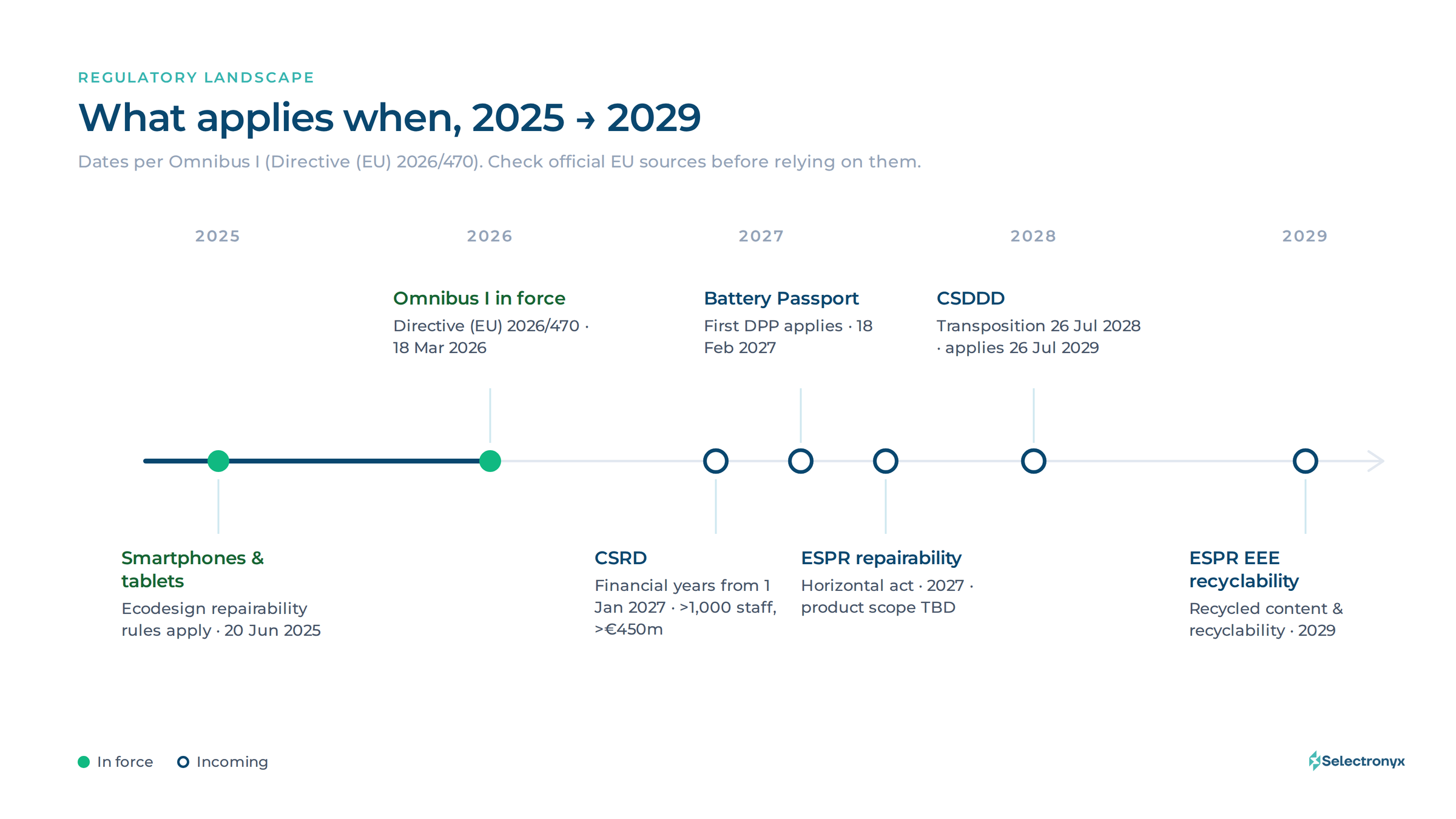
- CSRD after Omnibus I (Directive (EU) 2026/470, in force 18 March 2026). Narrowed scope: broadly, companies with more than 1,000 employees and more than €450m net turnover, applying to financial years beginning on or after 1 January 2027, with first reports typically in 2028.
- Smartphone and tablet ecodesign and energy-labelling repairability rules. Apply from 20 June 2025. Laptops are not yet in that scope.
- Right to Repair Directive (EU) 2024/1799. Requires national transposition, expected around 2026, before it applies across Member States.
- ESPR delegated acts. Incoming. First working-plan priority groups are textiles and apparel (2027), tyres (2027), furniture (2028), mattresses (2029), iron and steel (2026) and aluminium (2027), plus horizontal requirements: repairability (2027, scope to be confirmed, and it may later include consumer electronics) and recycled content and recyclability of EEE (2029). Electronics is not covered by a dedicated first-wave delegated act.
- EU Battery Passport. Applies from 18 February 2027, not 2026.
- EU Digital Product Passport for other product groups. Phased thereafter under ESPR delegated acts.
- CSDDD, or CS3D, after Omnibus I. Narrowed to broadly more than 5,000 employees and more than €1.5bn turnover. Transposition by 26 July 2028, application from 26 July 2029.
ESPR: how electronics is actually covered
The Ecodesign for Sustainable Products Regulation replaces the 2009 Ecodesign Directive with a framework capable of covering virtually every physical good placed on the EU market. It is worth being precise about what that means for electronics today, because the answer is less alarming and more awkward than the headlines suggest: the first working plan does not open with a dedicated electronics delegated act.
Near-term exposure comes instead through the horizontal requirements, which apply across product groups rather than to one of them. If your product later falls under those acts, components that cannot be replaced, that impede recyclability, or that fall short of durability expectations will create substitution pressure before the product reaches the market.
- Horizontal repairability requirements (2027), scope still being defined.
- EEE recycled-content and recyclability requirements (2029).
- Restrictions on substances that impede repair or recycling, as specified in later acts.
- Data availability obligations that feed Digital Product Passports once a product group is in scope.
What ESPR means for repairability
Repairability is becoming a mandatory product attribute rather than a design preference. In practice that means three questions about every component: whether it can be replaced in the field, whether spares will still be available when it needs replacing, and whether the package allows disassembly at all. Those are answerable from component data today, well before any delegated act names your product group.
Durability thresholds will raise the same kind of scrutiny for reliability. Material composition, recyclability and restricted substances will extend the substance question beyond the familiar RoHS and REACH packaging. And lifecycle cost becomes harder to leave implicit once the rules make its components explicit: repair cost, replacement frequency, end-of-life processing, and the cost of substituting a part late rather than early.
The Digital Product Passport and component lifecycle visibility
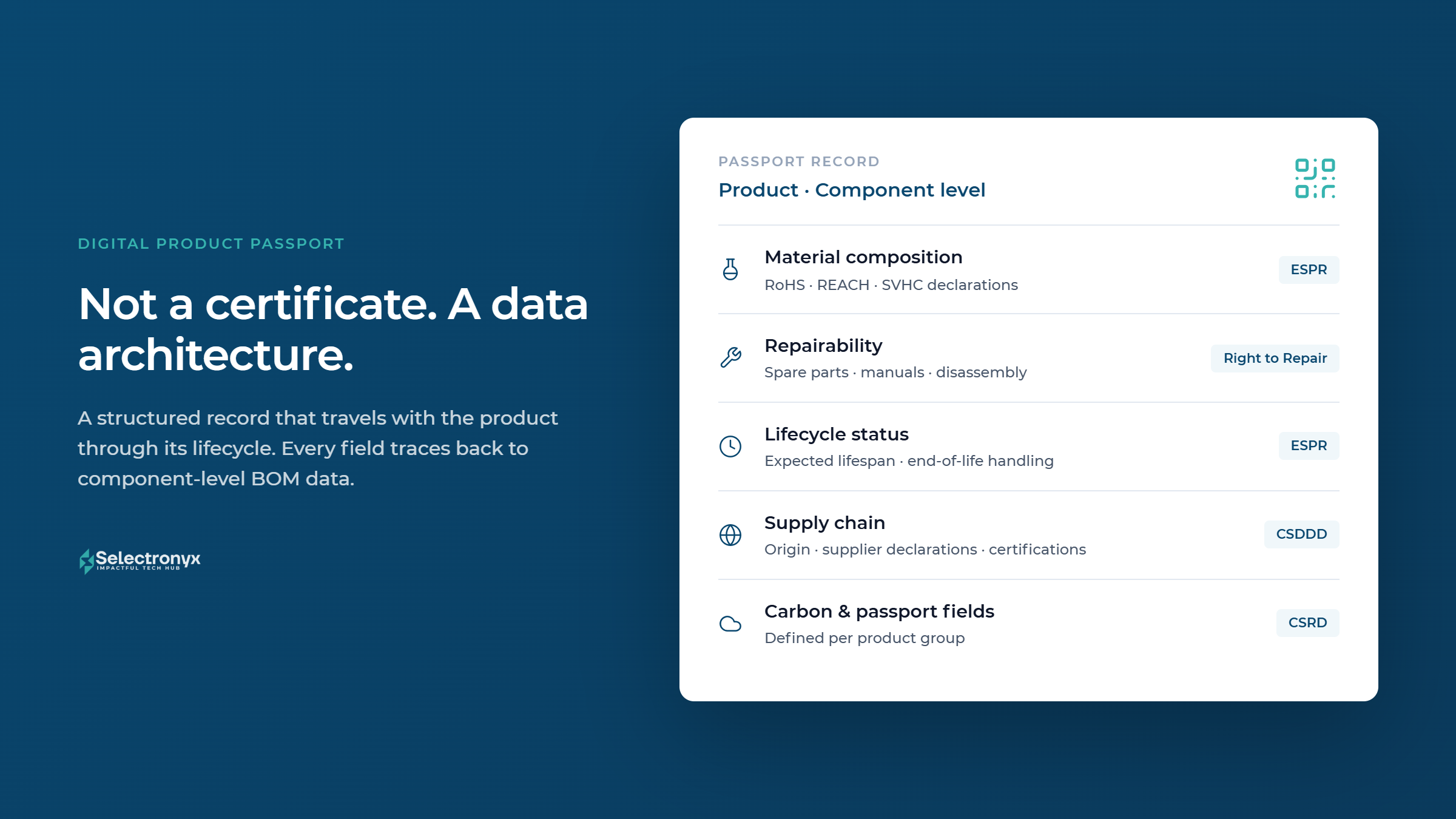
The DPP is the mechanism through which ESPR and the rules around it become machine-checkable: a structured data record that travels with a product through its life. Battery passports apply from 18 February 2027. Other product groups phase in under subsequent delegated acts.
It is not a certificate. It is a data architecture, and that distinction matters for how you prepare. A certificate is something you obtain at the end; a data architecture is something you are either already feeding or you are not. Teams whose compliance work already runs on structured component data will find they are most of the way there. Teams whose answers live in PDFs and inboxes will not.
CSRD after Omnibus I: narrower scope, later waves
Omnibus I narrowed CSRD considerably. In broad terms, mandatory reporters are now companies with more than 1,000 employees and more than €450m net turnover, applying to financial years beginning on or after 1 January 2027.
A fair number of teams are still preparing for a version of CSRD that no longer applies to them, which is worth checking before spending another quarter on it. For manufacturers that do remain in scope, Scope 3 purchased-goods emissions stay a material topic, and most still have no component-level carbon data at all.
CSDDD after Omnibus I: delayed and narrowed
CSDDD now applies, in broad terms, to companies with more than 5,000 employees and more than €1.5bn turnover. Member States must transpose by 26 July 2028, and obligations apply from 26 July 2029.
The useful thing to understand about CSDDD is that it does not require perfection. It requires documented due diligence: a defensible process for identifying risks and addressing them as they become known. A company that can show why it chose a supplier, what it knew at the time and what it did when that changed is in a considerably stronger position than one whose procurement rationale was never written down, regardless of which of them had the better outcome.
Right to Repair: what is in force today
Ecodesign and energy-labelling repairability rules for smartphones and tablets apply from 20 June 2025. Laptops are not yet in that first ecodesign cohort. Separately, the Right to Repair Directive (EU) 2024/1799 still requires national transposition before it applies more broadly.
- Spare parts available at reasonable cost for a defined period after market release, where a product group is in scope.
- Repair manuals and technical documentation for independent repairers.
- No software locks or design features that prevent independent repair.
- Diagnostic tools on fair, reasonable and non-discriminatory terms.
One data problem
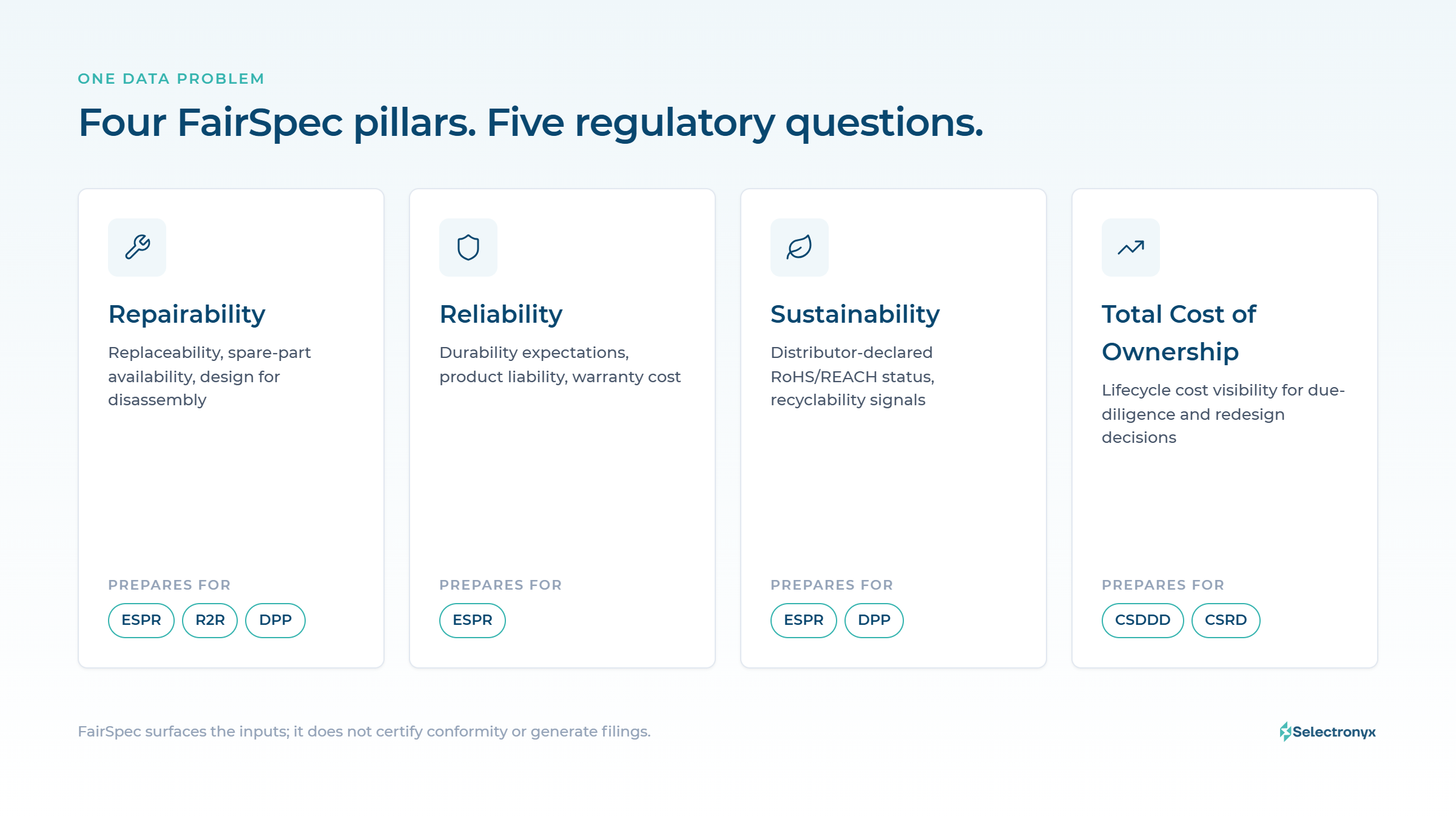
These are not five separate data-collection projects. They are five ways of asking one question: can you show, with traceable data, that the hardware decisions you made were reasonable ones at the time you made them?
The answer sits in the bill of materials, because that is where the component-level evidence behind every sourcing decision already lives, whether or not anyone has organised it.
Where to start
Three things are worth doing now, and none of them requires a new system.
Find out whether you are still in scope, and when. Omnibus I moved the headcount and turnover thresholds for both CSRD and CSDDD, and it moved them upward. Some teams have been preparing for a year against a version of the rules that no longer reaches them.
Work out which of this data your BOM already holds. Substance status and lifecycle are usually there in some form, even if scattered. Repairability signals and supply-chain provenance usually are not.
Start the record now rather than at the deadline. Every one of these regimes rewards a documented process over a perfect answer, and a documented process is only worth anything if it was running before the question was asked. The cheapest version of that is to begin recording what you already decide.
Keep reading
Go deeper with FairSpec component intelligence, what 1,273 open-hardware lines show about NRND and check a part without signing in.
Bring this clarity to your BOM
Selectronyx screens every component for lifecycle and risk and surfaces distributor-declared RoHS/REACH signals - no account needed to check a part.
Check a part - no account