
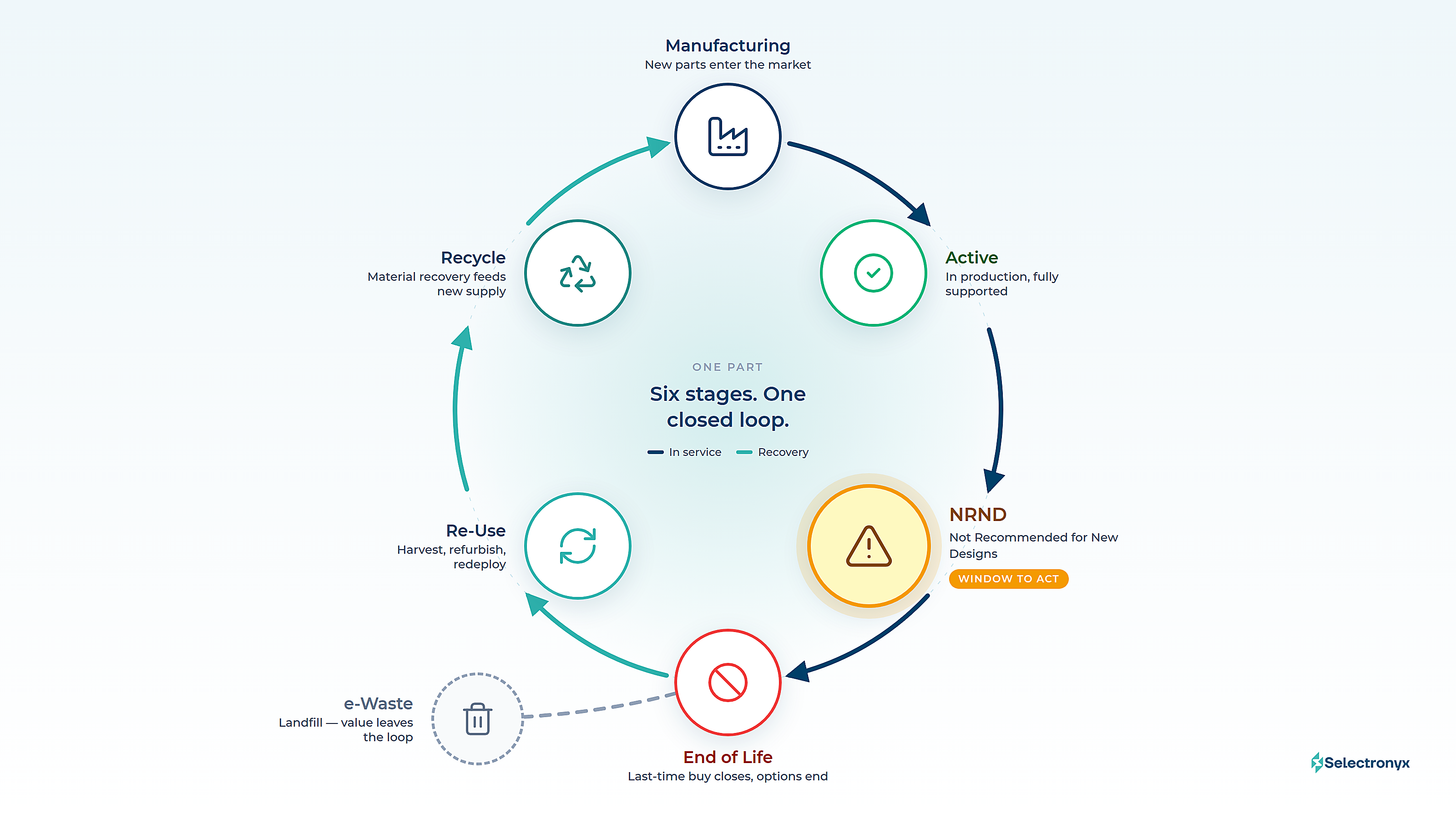
NRND is a warning. End-of-life is when the options close.
We scored 1,273 components from 50 published hardware designs. The sourcing problem does not begin where most teams look for it.
There is a white LED, Osram's LG L29K-G2J1-24-Z, that appears in six of the fifty published hardware designs we analysed. It is obsolete. Its last-time-buy date passed in April. One authorised distributor still lists it, holding five thousand units, and the last-time-delivery date is the last day of this year.
Come January, six published designs contain a part nobody can buy.
That is the subject of this article, not because the LED is unusual, but because it turns out to be entirely typical of what happens to a component when it dies, and because the timing is not what most procurement processes assume.
What we did
We took fifty bills of materials from public open-source hardware repositories on GitHub: 1,296 line items across designs spanning audio, RF, motor control, machine vision, industrial I/O, sensing and compute. We normalised them to a common schema, resolved 1,273 lines against live component data aggregated across more than seven hundred distributors, and scored every part for lifecycle status, sourcing depth and substance compliance.
The sources are public. We have deliberately not identified individual projects. This is an analysis of the state of open hardware bills of materials, not an audit of anyone's work.
Two limits, stated up front because they matter. These are maker and small-project designs, with a median of 23 lines; a mid-size manufacturer's BOM runs to hundreds. And this is a single snapshot in time, so everything below is association, not causation.
The obvious finding
Thirty-four of the fifty designs (68%) contain at least one part that is Not Recommended for New Designs or already end-of-life.
That is a striking number until you think about how it arises, at which point it becomes an unsurprising one. A design is published, it works, and the BOM is never looked at again. Component lifecycles run on their own clock, entirely indifferent to whether anyone is watching. Nothing in a repository sends you an email when Texas Instruments deprecates a regulator.
Two thirds of published designs carrying a dying part is not evidence of carelessness. It is what happens when a static document meets a moving supply chain.
Twenty-three lines, across all fifty designs, resolved to no distributor catalogue at all. Not obsolete, totally absent. Whatever the design intended, that part is now a research project.
The finding that actually matters
Across all 1,273 resolved lines, 15.6% are sole-sourced: available from fewer than two authorised distributors. That is the background rate.
Now split it by lifecycle stage.
Nothing in this data separates an NRND part from any other part in the design, thirteen percent against a background of sixteen. A part that has actually reached end-of-life is sole-sourced six times in ten, roughly four times the background rate, and that gap is far too wide to be a trick of the sample.
Sourcing risk does not accumulate gradually as a component ages. It arrives, more or less all at once, at the moment the part actually dies.
Why the collapse is sudden
The mechanism is simpler than it first appears, and it is worth being precise about, because the shape of the curve is what determines when you should act.
A manufacturer marks a part NRND to steer new designs elsewhere. It is a signal about the future, not the present. The part is still in production. Distributors still stock it, because it still sells with an installed base building it, and demand looks much as it did last quarter. From a purchasing screen, an NRND part looks entirely healthy, and our data says it broadly is.
End-of-life is a different event. Production stops. What remains in the channel is inventory, and inventory drains at wildly different rates across distributors depending on who happened to be holding stock. The large catalogue houses clear their positions and delist. Whoever still shows availability is often a single distributor working through the last reel, or a broker with no authorised relationship at all.
So the distributor base does not taper. It falls off a cliff, and it falls at precisely the moment your ability to respond is worst: by then there is no more of the part being made.
The practical consequence: NRND is a warning with time attached to it. End-of-life is a notification that your options have already narrowed. By the time a part is EOL, six times in ten you are looking at a single supplier and a last-time-buy decision you did not schedule.
Why nobody sees it coming
None of this is secret. Lifecycle status is published, distributor counts are visible, and it may seem obvious that an obsolete part is harder to buy. And yet two thirds of these designs are carrying one.
The reason is that BOM risk is a monitoring problem disguised as a design problem.
A bill of materials is checked hardest at the moment it is created, during design review, when every part is chosen deliberately and its datasheet is open on somebody's screen. That is also the moment when the risk is lowest, because the parts were selected for availability. Everything that goes wrong afterwards happens to a document nobody is reading.
There is no natural trigger. Lifecycle status changes on the manufacturer's schedule. Distributor stock positions change weekly and silently. A part can move from Active to NRND to EOL across two years in which nobody on your team has any reason to open that spreadsheet, until the day a build stalls and somebody finds out the hard way.
Our concentration data supports this reading. The clustering is not spread evenly: it is heaviest in optoelectronics and integrated circuits, and it recurs on specific part numbers. Two Cirrus Logic audio codecs, CS4344-CZZ and CS5343-CZZ, each appear in three designs. Both are obsolete, and between them they have no authorised distributor left at all: not one, in either case. These are not obscure choices. They were sensible parts when the designs were made, and time simply moved.
Where the substance risk was not
One result cuts against the story, and it is worth reporting for that reason.
RoHS coverage was good. Of 1,273 resolved components, 1,173 (92.1%) carried a RoHS status in the aggregated data. Two were flagged non-compliant.
One is a cadmium sulphide photocell, Advanced Photonix's PDV-P8001, a light-dependent resistor whose sensing element is, by construction, cadmium sulphide. Cadmium is one of the ten substances RoHS restricts, capped at 0.01% by weight in any homogeneous material. A CdS cell cannot approach that limit, because the restriction bars the operating principle rather than a manufacturing choice, which is why the part class quietly left new designs a decade ago. Two independent sources report it non-compliant; the datasheet makes no compliance claim at all.
That one needed no adjudication. The chemistry is the finding.
The other is a memory part flagged by a single source that we could not corroborate: it is obsolete enough that no catalogue still lists it, and the manufacturer's declaration is not public. We are reporting it as a flag we could not confirm rather than as a finding, and have not named it.
One confirmed failure in 1,173 assessable lines, and one we could not stand behind. Call it under two in a thousand either way. In this study, restricted substances were not where the risk lived, and where a substance problem existed at all, it was attached to a part that was already dying. The same pattern again, from a different direction.
What this is and is not
Some numbers deserve their caveats in the same breath.
The end-of-life figure rests on sixty parts and the NRND figure on thirty. Sixty is enough to be confident the effect is real, not enough to pin its size down precisely; call it "most", not "exactly 60%". Thirty is weaker still, and thirteen percent of thirty is four components. What we can say is that we found nothing separating NRND parts from the background, not that we proved there is nothing to find. The advice below does not rest on either figure exactly. It rests on the distance between them, which no plausible sampling error closes.
It is also one snapshot, concentrated in optoelectronics and integrated circuits, of fifty open hardware designs. We are not claiming a law of components.
A mid-size manufacturer's BOM, under active procurement management, will look better than these, although it may not be as optimal as you'd expect. What produces these numbers is a monitoring gap, and a monitoring gap does not close because a purchasing team exists. It moves to the parts nobody has a reason to open: the second sources, the passives, the connector that has been the same since 2019. Those are exactly the lines that quietly lose their distributors.
One last thing about the compliance numbers. Aggregated component data returns a normalised status: compliant, non-compliant, or nothing. It does not carry the declaration underneath, the directive version it was assessed against, whether a manufacturer or a reseller said it, or a date. That makes a status a useful screening signal and a poor substitute for a declaration. Read every figure in that section as what the channel says about these parts, not what the parts contain.
What to do about it
Three things follow, and none of them requires new tooling to start.
Treat NRND as your action point, not your alarm. The data says an NRND part is still comfortably sourceable. That is exactly why it is the right moment to qualify an alternative, as you have a functioning supply chain while you do it. Waiting until EOL means qualifying a replacement while your remaining stock drains, which is the same job done under pressure with fewer options.
Check the BOM on the supply chain's clock, not your project's. The document does not change; the world underneath it does. A design that was clean at freeze is not clean two years later, and nothing will tell you unless you ask.
Watch the distributor count, not just the lifecycle flag. Sourcing depth is the earlier signal. A part quietly dropping from five authorised distributors to two is telling you something before any status field changes.
None of this is new to anyone who has managed a mature product line. What the data adds is the timing: the risk is not a gradient you can watch approaching. It is a step change, and it happens at the point where you can do least about it.
Thanks to our data partners


Lifecycle, sourcing and compliance data for this study came from Nexar/Octopart, which aggregates catalogue data across more than seven hundred distributors. DigiKey was consulted as an independent second source on every compliance flag. Neither partner reviewed this analysis, and any errors in it are ours.
Keep reading
Put the monitoring habit to work with component lifecycle intelligence, BOM risk checking and a no-login part check.
Bring this clarity to your BOM
Selectronyx screens every component for lifecycle and risk and surfaces distributor-declared RoHS/REACH signals - no account needed to check a part.
Check a part - no account